If I was ever asked to name African
American actors that have played a role of a police officer, I would have named
Terry Cruz, from ‘Brooklyn Nine-Nine’, Martin Lawrence, from the ‘National
Security’ or ‘Bad Boys’, and Kevin Hart, from the ‘Ride Along’. Interestingly
enough, these actors playing police officers are comedians or at
least depicted as comedic in fictional media. While the specified genre is
classified as crime comedy, a large portion of black actors that play police
officers are usually being segmented into comedic roles. Repeated
representations of African American police officers as either comedic or ‘sellouts’ in
film or television shows, can therefore impact public perceptions and enable
them to adopt similar beliefs from the messages they have received, this is
known as cultivation theory (Wimmer &Dominick 2003).
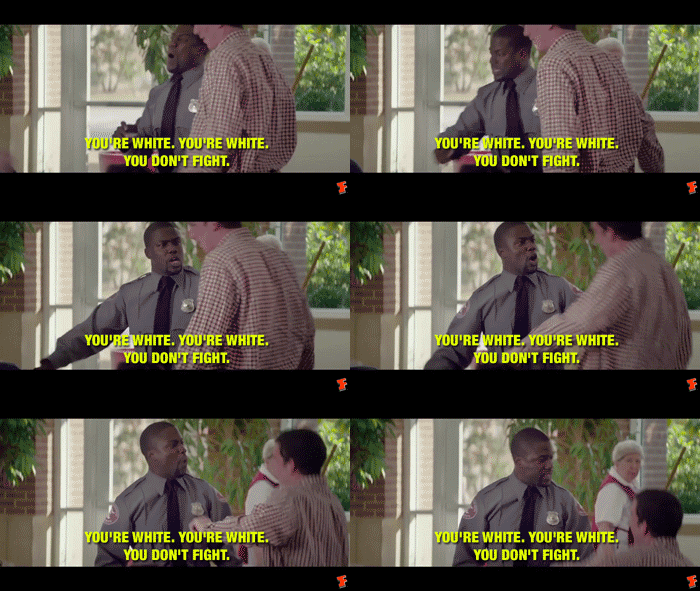
The film 'Ride Along' depicts two stereotypes
that are played out by African American actors in fictional crime genres. Ice Cube acts as a rogue cop that disobeys
orders to catch his culprit and to gain more information he uses excessive
violence towards the people in his community. This relates to depictions of
double marginalisation towards African American police officers according to
Henderson & Wilson (2014). Traditionally,
police have been known for oppressing minority groups. Therefore black police
officers are perceived to be selling out their community as they become the
very thing that oppressed the minority groups, while those same officers are
pressured by the police department that employs them. This double
marginalisation could be taking effect, as many African Americans still stigmatise
law enforcement let alone pursue a career in it (Rocque 2011).
On the other hand, Kevin Hart serves as the
“primary source of comedy in the film” (Henderson & Wilson 2014 pg.57) he
is usually placed into comedic situations or producing it himself through
comedic conversations with other characters. It should also be noted that the
jokes that he expresses plays towards racial stereotypes of the black community
in the US. Alluding to Stephen Fetchit, a black actor that comically
popularised African American stereotypes for White audiences in the 1920s, this
form of entertainment is still prominent today (Henderson & Wilson 2014).
Does this mean that the public expects black police officers to act according
to the comedic stereotypes that the media has designed for them? Personally, I
believe that racial expectations of black police officers that have been
cultivated through repeated messages are disposed when they are put in that
position of authority. If I am ever pulled over by a police officer, expectations of their racial stereotypes, are the least of my concerns. In fact, the cultivation effect only works to some
extent, the media alone does not completely direct how people perceive social
realities. Moreover, the quality of cultivation is not addressed; similar messages, like
the similar format we see in these comedic buddy cop movies, might not be
persuasive in directing public perception. Furthermore, social norms are constantly
being reinvented and challenged in both the society and the media, so the depiction of African American police
officers in film could be weakening the effects of cultivation. While it is tempting for comedies to appeal to racial humour, current programs are attempting to promote more multiculturalism.
 |
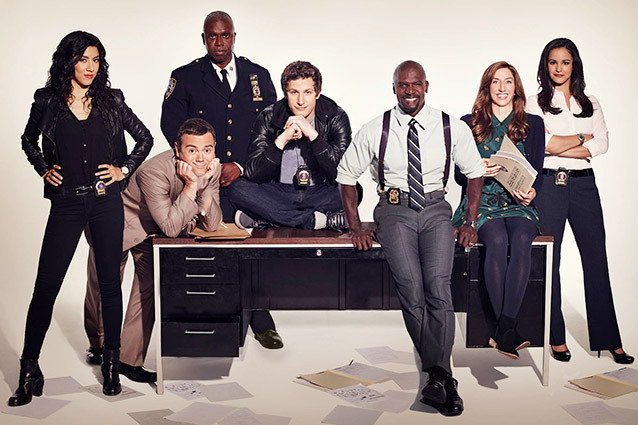
| Brooklyn Nine-Nine TV sitcom |
In terms of crime comedy in television, a current
series, ‘Brooklyn Nine-Nine’ is a police sitcom that looks into the lives of
police detectives in the 99th precinct of the New York Police
Department (NYPD). It is acclaimed for being the “best representation of
minorities on television” (Cintron 2013), as the show does not derive its
comedy from racial differences and stereotypes. In fact, the two black
characters are in high positions both a captain and lieutenant (Andre Braugher
and Terry Crews), but what is highlighted are their comedic personalities
rather than playing to stereotypes. In a way, this could be a comment on how contemporary societies should act towards minority police officers in the criminal justice system. The current evolution in our media messages
suggest that while race creates part of our identity, it is not the only thing
that defines people. I believe through new forms of media and its content can promote equality. The audience determines social realities as we gain more power in picking the content that we want to view. Through this, we directly change the messages generated by the media proprietors, and these messages break away from cultivated racial stereotypes of minority police officers in the criminal justice system.
References
Cintron,
C. (2013). 'Brooklyn Nine-Nine' and The Future of Diversity.
[online] Hollywood.com. Available at:
http://www.hollywood.com/news/tv/55038595/brooklyn-nine-nine-future-diversity
[Accessed 30 May. 2014].
IMDb,
(2014). Ride Along (2014). [online] Available at:
http://www.imdb.com/title/tt1408253/ [Accessed 30 May. 2014].
Rocque,
M. (2011). Racial Disparities in the Criminal Justice System and Perceptions of
Legitimacy A Theoretical Linkage. Race and Justice, 1(3),
pp.292--315.
Wilson,
F. and Henderson, H. (2014). The criminological cultivation of African American
municipal police officers: Sambo or sellout. Race and Justice,
p.2153368713517396.
Wimmer,
R. and Dominick, J. (1994). An introduction to mass media research. California:
Wadsworth.
Imageshttp://media.giphy.com/media/isuP10eT3Pruo/giphy.gif

I love Brooklyn 99, such a great show. I hadn't previously given much thought to the way in which race is depicted/represented in the show, but it's certainly food for thought for the next series.
ReplyDeleteAlyce